In a world where websites can be built in hours and content generated in minutes, the hardest thing is no longer creating — it’s staying recognisably yourself.
We often talk about personalisation as though it is a feature. Something nice to have. Something that can be added later once the important things are done.
I don’t think that’s true.
The more I look at businesses, brands, websites, and content online, the more I believe personalisation is becoming increasingly important — not because it helps you stand out, but because it helps you remain yourself.
What accessibility changed
Technology has made it easier than ever to create things. A website can be built in a matter of hours. Content can be generated in minutes. Design systems, templates, and AI tools have lowered the barrier to entry across almost every industry.
This is not necessarily a bad thing. In many ways, it is a positive development. More people can build, create, and participate than ever before.
But there is a consequence that comes with accessibility: what was once considered exceptional eventually becomes common.
- A professional-looking website was once a competitive advantage. Today, it is an expectation.
- A polished social media presence was once impressive. Today, it is routine.
- Content creation, which previously required significant time and effort, is becoming increasingly accessible.
As more things become easier to create, the challenge is no longer creating them. The challenge is ensuring they still represent who you are.
Every business has a language
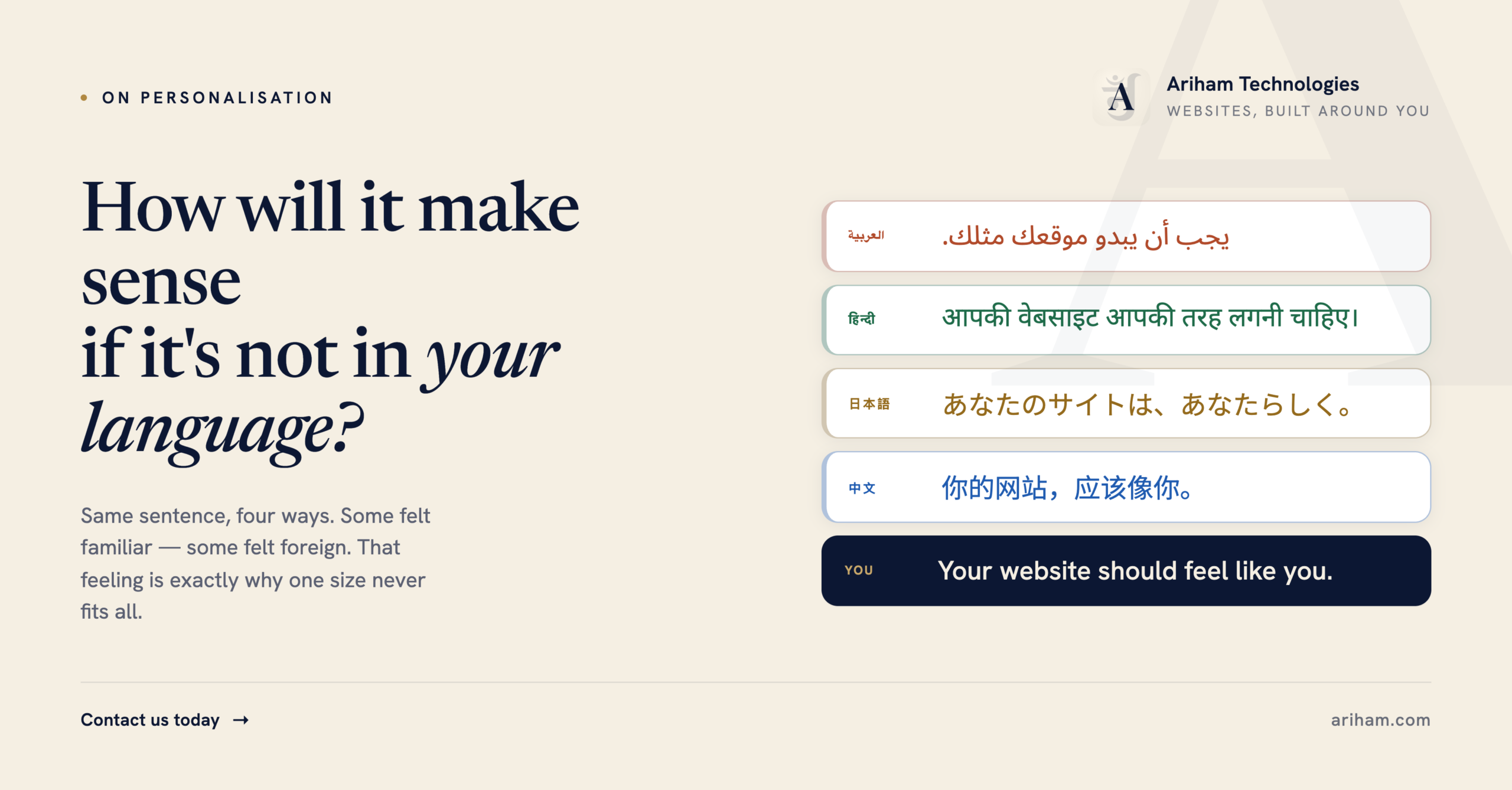
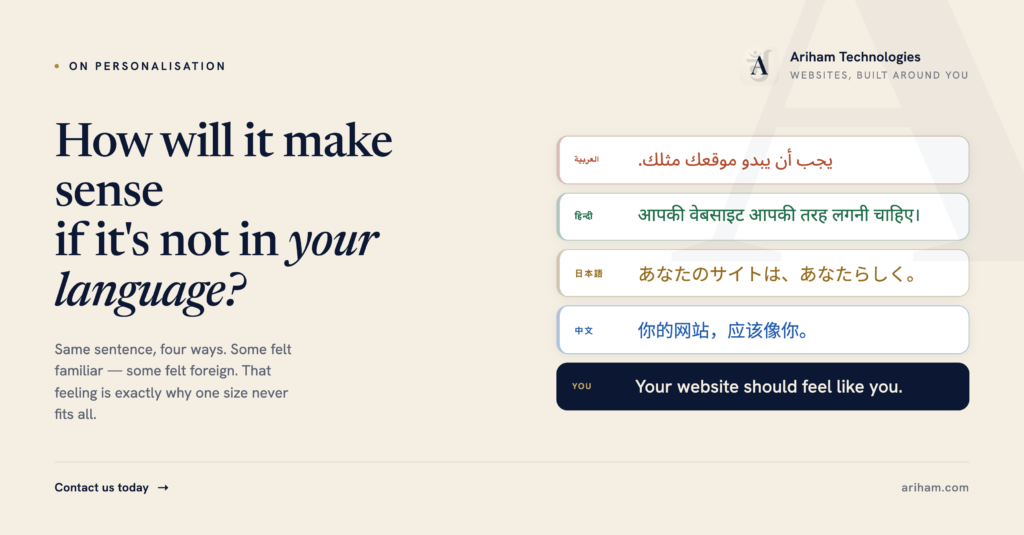
When we talk about language here, we are not talking about English, Hindi, or any spoken language. We are talking about the way a business expresses itself — its voice, its values, its way of thinking.
Some businesses communicate through warmth and relationships. Others through expertise and precision. Some focus on community; others on craftsmanship. Some are built around speed and convenience, while others are built around trust developed over decades.
Yet many businesses lose that language when they move online.
They begin sounding like everyone else. The same headlines. The same promises. The same layouts. The same messaging.
The website may look professional, but it no longer feels connected to the people behind it.
Why that disconnect matters
When customers interact with a business, they are not only evaluating a product or service. They are evaluating the thought of the people behind it — trying to understand whether the business is trustworthy, whether it understands their needs, and whether it is aligned with what they value. And most importantly, whether they value them.
This is one of the reasons some businesses continue to thrive for decades. Customers don’t keep returning simply because a product they like is available. They return because trust has been built over time. They know what to expect. They know the standards. They know the people.
Trust becomes attached to identity.
That identity is often what customers remember long after they have forgotten a specific advertisement, campaign, or offer.
The same principle applies online. A website is not merely a collection of pages. It is often the first impression a business creates — a digital representation of the people behind it. Whether intentionally or not, visitors form opinions based on what they see, read, and experience.
If that experience feels generic, the business becomes easier to forget. If it feels authentic, customised to their need, easy to navigate for instance, the business becomes easier to remember.
For example, you wouldn’t place a door handle at the same height in a preschool that you would in an office building. Design changes when the people using it change. Websites should be approached the same way.
What personalisation actually means
This is why we place so much importance on personalisation and customisation — not because every website needs to be radically different, and not because every business needs to reinvent the wheel.
But because every business deserves to be represented accurately.
A website should communicate how you think, what you value, and how you serve people. It should reflect the identity that already exists within the business rather than replacing it with a template that could belong to anyone.
The way you think about your customers matters. The standards you set matter. The values you uphold matter. The respect you show people matters. Customers may not always articulate these things, but they notice them.
Identity is the one thing that cannot be replicated
In a world where more and more things are becoming standardised, identity becomes increasingly valuable. It is one of the few things that cannot be easily copied.
Others can use the same tools. Others can use similar designs. Others can offer similar services.
What they cannot replicate is your perspective, your experiences, your values, and the trust you have built over time.
That is the power of identity. It survives trends. It survives platforms. It survives technological shifts.
I believe technology should help people and businesses express who they are, not hide it. Whether it is a website, a piece of content, or an entire digital presence, the goal should not be to fit people into a template but to communicate what already exists: their values, perspective, and way of doing things.
Perhaps that is why I have never been particularly convinced by one-size-fits-all solutions. Best practices have their place, but they often fail when removed from context. A strategy that works brilliantly for one business may be entirely unsuitable for another. The same applies to websites, content, communities, and even leadership. The moment we stop asking who we are building for, we risk creating something that is technically correct but fundamentally disconnected from the people it is meant to serve.
Trends will continue to change. New tools will emerge. Technology will evolve. Yet some things remain remarkably consistent. People still want to know who they are dealing with. They still care about trust, authenticity, and shared values. They still want to feel understood.
Being human, and the thought that goes into understanding other humans, never goes out of fashion.
That is why we’ve built Ariham Technologies. If you resonated with the article, hopefully, we’d have a good time working together.